
// Family Law
By the time they search 'divorce lawyer,' they've been served for days.
A respondent served with divorce or custody papers is holding a deadline they don't understand. The attorney who reaches them first isn't ambulance-chasing — they're answering a question the reader is desperately asking.
Explore Your MarketThe short answer
Family law leads from Leads For Lawyers are new divorce, custody, and support filings harvested from court records daily and answered with a same-day personalized letter to the respondent — the party holding a deadline and, usually, no lawyer. Each piece carries the recipient's name, the matter type, and a matter-matched brochure under your firm's name, mailed First Class in your chosen counties.
New to the model? Read how it works step by step, or start with the complete guide to legal direct mail.
Family law has a structural quirk most marketing ignores: one side chose the timing, and one side didn't. Petitioners interview attorneys before filing. Respondents find out when the papers arrive — and their response clock is already running.
We harvest new family filings daily — divorce, custody, support — and mail the respondent a personalized piece the same day: their name, the matter type, and a brochure explaining what a response deadline means and why counsel matters now.
It arrives while the petition is still sitting on the counter. For the reader, it's clarity at the exact moment of confusion. For your firm, it's the case before it ever reaches a search engine.
// What you subscribe to
- Daily divorce, custody, and support filings
- Respondents on every filing; unrepresented petitioners optional
- Matter-matched brochures, composed per recipient
- County-level market selection
- QR + tracked-number attribution
// The piece
What the family law piece looks like.
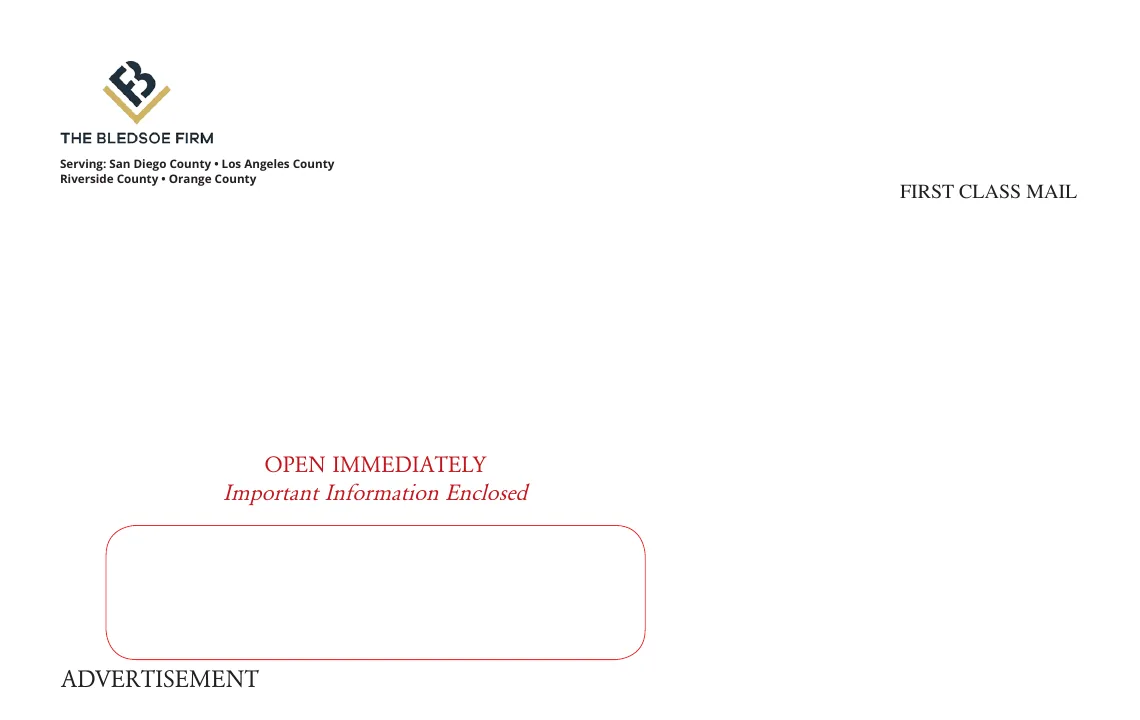
Addressed to one person. First Class, mailed the day the record is harvested.
Client piece · The Bledsoe Firm · Newport Beach, California · family law
The mail piece arrives as a First Class envelope addressed to the defendant, containing a personalized letter and a brochure whose front cover names the specific offense.
Family law leads from the court record, not a form-fill
Companies selling divorce leads mostly sell web inquiries: someone searched, clicked an ad, typed a phone number into a form — then that form was sold, sometimes to several firms. The petitioner side of a divorce shops that way. The respondent side doesn't shop at all; they get served, and their deadline starts whether they've found a lawyer or not.
Our family law program runs on the filing itself. New divorce, custody, and support filings are harvested from court records daily, and the respondent receives a personalized letter the same day — their name, the matter type, and a brochure that explains what a response deadline actually means. No form was filled. No list was sold. The court created the record; your letter answered it first.
Divorce direct mail that respects the moment
Nobody wants the letter that arrives the week they were served to be loud. The piece we compose is deliberately the opposite of an advertisement in tone: factual, calm, specific to the matter type, and honest about why counsel matters before the deadline. It's the register a good attorney would use in person — which is why it gets kept, and why the firm whose name is on it starts the relationship ahead.
Every piece carries the required advertising labeling, follows each state bar's written-solicitation rules, and is written for the recipient's own matter. The calls it produces ring your phone, tracked and attributed campaign by campaign.
Respondents on every filing — unrepresented petitioners on request
Every new filing names two parties, and only one of them chose the timing. The petitioner usually has counsel before the clerk stamps the case; the respondent almost never does. So the program mails the respondent on every family filing in your market — the party holding a deadline and no lawyer.
Petitioners are a narrower case, and the record settles it. Most firms want a petitioner only when the filing shows no attorney of record — a pro se petitioner in a support or modification matter, say — and that is exactly how the option runs: petitioners are added to a subscription only where the record shows them unrepresented, set by county and matter type. Family law marketing built on the court record leaves that choice where it belongs — with your firm, set once at subscription and honored every day after.
Family law direct mail across the whole docket — new divorce filings first
Divorce is the headline, but the docket is wider: contested and uncontested divorce, child custody, child support, paternity, alimony and property division, post-judgment modifications. Every category gets the same treatment — harvested the day it's filed, answered with a matter-matched piece the same afternoon.
Concentration beats coverage. The firms that get the most from family law direct mail rarely mail everything; they pick the counties they intend to focus on and the matter types their practice is built for — new divorce filings in three high-value counties, say, and nothing else. The daily harvest honors that filter, and every letter inside it is written for the respondent it reaches.
The mechanism behind every program is the same — read how it works end to end, see how every piece is measured, or start with the complete guide to legal direct mail.
// Questions attorneys ask
Family Law direct mail, answered plainly.
What are divorce leads?
Divorce leads from Leads For Lawyers are new divorce, custody, and support filings harvested from court records daily, with the respondent mailed a personalized letter the same day under the subscribing firm's name. The term usually means contact information from people who filled out a web form while researching divorce, sold to law firms per lead — a different product.
How do attorneys find new divorce filings?
Attorneys find new divorce filings in the public court record, and Leads For Lawyers collects those filings daily in every state so a firm never has to. Each filing is filtered to a subscribing firm's counties and matter types and converted into a same-day personalized First-Class letter to the respondent — the party holding a deadline and, usually, no lawyer.
Is it appropriate to mail someone who was just served?
Yes, done correctly — a Leads For Lawyers family-law letter reaches a respondent who is holding a legal deadline and usually has no counsel, so a factual, calm explanation is often the most useful mail they receive that week. Every piece follows state bar written-solicitation rules, carries required labeling, and is written for the sensitivity of the moment.
Can a Leads For Lawyers family law program cover several counties?
Yes — a Leads For Lawyers family law program can cover several counties or a single one, set by county and matter type at signup. Every new filing inside that scope becomes a letter written for the respondent about their own matter, mailed First Class the same day under the firm's name, and every tracked call comes to the firm's phone.
Can attorneys reach both petitioners and respondents?
Respondents, always — Leads For Lawyers mails the respondent on every family filing in a subscribed market. Petitioners are optional and confined to filings where the record shows no attorney of record: most firms want to reach a petitioner only when they are unrepresented, and the subscription is configured that way, by county and matter type.
What matter types does the family-law harvest cover?
The Leads For Lawyers harvest covers the family docket end to end: contested and uncontested divorce, child custody, child support, paternity, alimony and property division, and post-judgment modifications. Firms subscribe to the counties and matter types they want, and the daily mailing covers exactly that selection.
// Compliance
Family-law solicitations follow all applicable bar rules on written outreach, with required labeling and a tone reviewed for the sensitivity of the moment.
// Also available in your market